
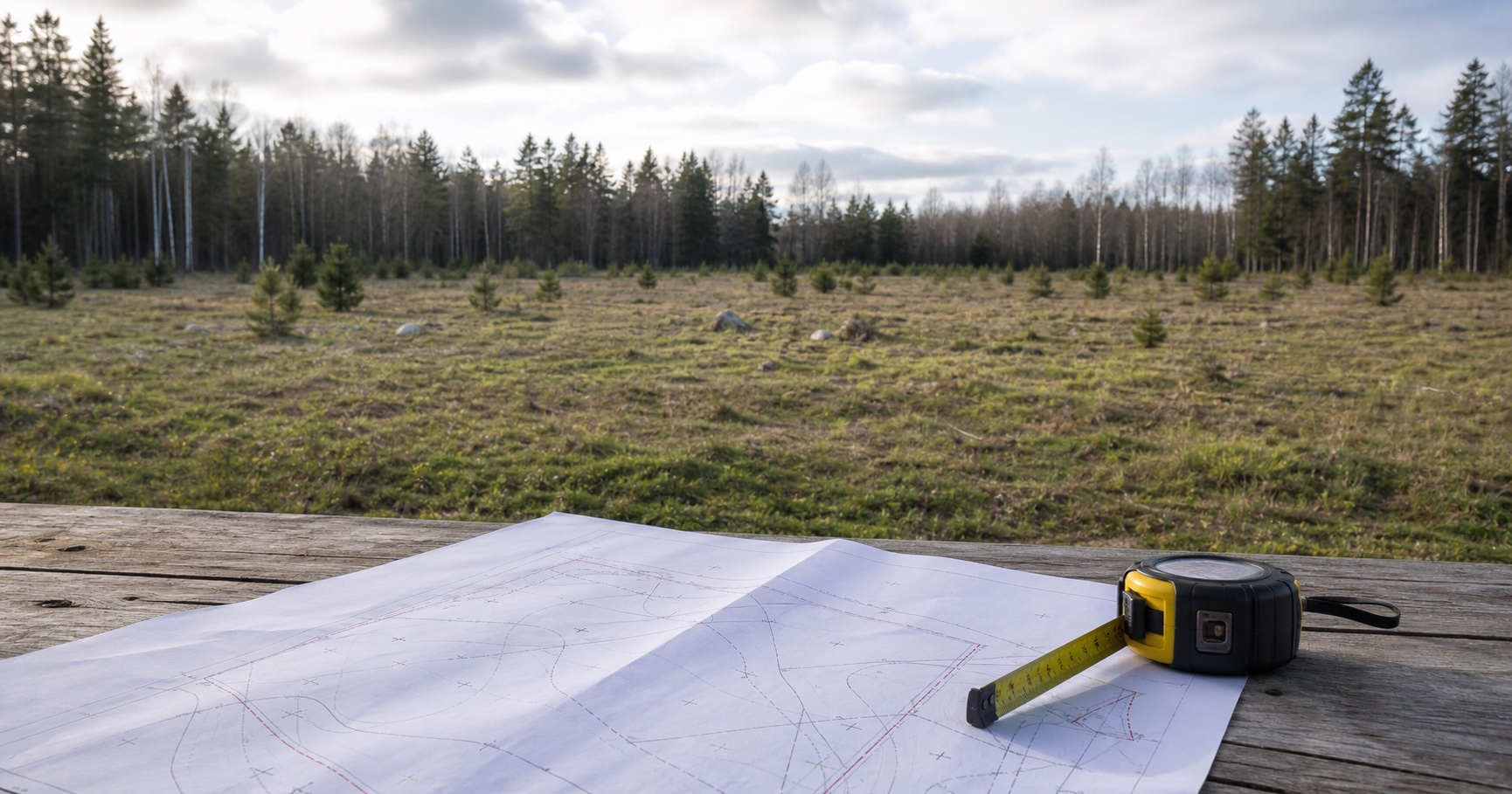
Season 2. The land that was more complicated than the house · Episode 1
This story is based on real events. Names, exact addresses, selected dates, amounts and some identifying details have been changed or combined to protect the participants’ privacy.
After some time, the same owner contacted me again.
This time, the task was to sell plots of land.
I thought that after the modular house, land would be easier. At least it did not have to be transported.
The plots were large, around three hectares each. Forest, open land, a road, proximity to Tallinn.
In a listing, it could all fit into a few attractive sentences.
But first we had to answer the main question for a buyer: can a residential house be built there?
One of the plots had agricultural purpose and was located in Rebala, a protected historical landscape area.
A large area did not mean freedom to build.
Engineering networks and their protection zones crossed the land.
Part of the plot fell within the protection zone of a state road.
We had to consider forest, distances from boundaries and neighbouring residential buildings, archaeological heritage and requirements for preserving the landscape.
I had to go through geodetic materials, conditions from the municipality and approvals from several authorities.
The answer was positive: construction was possible.
But only in a certain part of the plot, while preserving tall trees and with architecture suitable for the historical environment.
One residential house and up to two auxiliary buildings were allowed. Restrictions were set for area, height, roof shape and facade materials.
Even the colour and appearance could not be left entirely to the future owner’s taste.
Another unexpected point appeared in the documents: the plot was in an area with increased radon risk.
That also had to be considered during design.
The phrase “building right exists” looked simple in the listing.
Behind it stood work with the municipality, Muinsuskaitseamet, Transpordiamet, surveyors and network owners.
When the restrictions on the first plot finally became clear, it turned out that the problem with the second object was not in the land.
It was in the owner’s documents.
Next part
Part 2. The house that was not real estate
People lived in the house, the water, electricity and heating worked. But the object of the sale was a structure that could be divided into four modules and moved away.
Read next partDo not miss the next part
Leave your email and I will send the next part after it is published. No daily emails and no unrelated advertising.